
3rd Quarter, 2026

Global deficits will continue to push long term rates higher.
The Markets
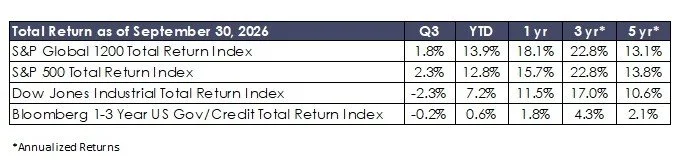
Financial markets enter the final quarter of 2026 navigating an increasingly complex mix of geopolitical tensions, rising long-term interest rates and uneven economic conditions. Despite these crosscurrents, corporate earnings and continued investment in artificial intelligence (AI) have helped sustain equity market strength. Our outlook remains cautiously optimistic, but valuations leave less room for disappointment if we face additional shocks to the global economy.
The central question is whether earnings growth can keep pace with the rising cost of capital. The cyclically adjusted price-to-earnings ratio for the S&P 500 is now nearly 42x higher than it has been at any point since the tech bubble of the late 1990’s when it peaked at 44x. Higher treasury yields could pressure equity valuations, particularly among companies whose prices depend heavily on distant future earnings. Market concentration and growing credit risks add to the potential for volatility.
For investors, it is important to make the distinction between an optimistic stock market and attractive investment opportunities. Broad market earnings growth can support further gains, but disciplined security selection and reasonable entry valuations remain essential for long-term investment performance through a market cycle.
The Economy
The U.S. economy continues to demonstrate resilience, although its underlying strength is unevenly distributed. Real GDP grew at a 2.2% annualized rate in the second quarter of 2026, following 2.5% growth in the first quarter. The labor market remains relatively stable with unemployment at 4.2% in September. Nevertheless, consumer confidence has weakened considerably, reflecting persistent concerns about living costs, energy prices, future employment conditions and geopolitical risks.
This divergence is important. Higher-income households continue to benefit from financial asset appreciation, supporting consumption, while less well-heeled households face greater pressure on discretionary spending. Corporate investment, particularly in AI infrastructure, provides another important source of economic momentum.
Looking ahead, earnings growth and productivity gains offer reasons for optimism. However, the benefits of AI investment must ultimately translate into sustainable revenues, profits and returns on capital. If higher interest rates, energy costs, or geopolitical disruptions undermine those expectations, both economic growth and equity valuations could come under pressure.
Our base case remains one of continued economic expansion, but with a wider range of potential outcomes than the headline growth figures alone might suggest.
Investment Strategy
As we approach year-end, we are reviewing portfolio positioning, realized capital gains and anticipated cash requirements for 2027. Tax planning is an important part of this process. Where appropriate, we will evaluate opportunities to realize gains, harvest losses, and manage the timing of taxable income. Potential legislative changes deserve consideration, but tax decisions should be driven by each client's circumstances rather than speculation about future policy.
Market uncertainty reinforces the importance of maintaining a strategic allocation aligned with long-term objectives. We continue to evaluate existing holdings against the investment theses that originally justified their inclusion. When a company's fundamentals deteriorate or its prospects no longer compare favorably with available alternatives, we will consider replacing it. At the same time, market volatility can create opportunities to invest in high-quality businesses at more attractive valuations.
Our long-term objective remains unchanged: to preserve purchasing power and build a growing stream of income that supports clients' spending needs over time. Achieving that objective requires balancing growth, income, liquidity and risk while not attempting to predict every market turn.
Fixed income presents a more compelling income opportunity than it did during the era of exceptionally low interest rates, but quickly rising long-term yields create meaningful price risk for existing bondholders. We continue to emphasize short-duration U.S. Treasury obligations for liquidity and capital preservation, while remaining attentive to opportunities to extend duration when compensation for interest rate risk becomes attractive.
Growing Geopolitical Crosswinds Creating Risks to the Dollar
The dollar's role as the world's principal reserve currency remains a significant advantage for the United States, supporting demand for Treasury securities and facilitating international trade. However, growing geopolitical fragmentation, fiscal deficit concerns and central-bank diversification are gradually challenging the assumptions that have underpinned this position.
Foreign governments continue to hold substantial Treasury portfolios, although their allocations shift over time. U.S. Treasury data show that Japan, the largest foreign holder of U.S. Treasury debt, held approximately $1.12 trillion in Treasury securities in June 2026, while China's holdings were approximately $633 billion, making it the third largest holder after the United Kingdom. These figures illustrate both the scale of foreign participation and the importance of distinguishing individual countries' decisions from broader global demand.
Central banks have also increased their strategic interest in gold. The World Gold Council reported that gold had overtaken U.S. government bonds as the largest reserve asset by market value, reflecting both purchases and the appreciation of gold prices. This diversification is a meaningful long-term development, but it does not establish that the dollar is on the verge of losing its dominant role. However, China will look for opportunities to mount dollar challenges.
An important counterbalance is the continued demand for U.S. assets, including equities and AI-related investments. The dollar's trajectory will depend on the interaction of capital flows, relative economic performance, fiscal credibility and investor confidence. We view gradual reserve diversification as a risk to monitor, rather than a reason to abandon dollar-denominated assets.
Macro-Economic and Geopolitical Challenges
The most consequential macroeconomic risk is the possibility that persistent fiscal deficits and elevated government borrowing push long-term interest rates materially higher. Investors require compensation for inflation uncertainty, the supply of new debt and the opportunity cost of committing capital for extended periods. Central banks can influence short-term rates, but they cannot independently resolve structural fiscal imbalances.
Higher long-term yields have implications well beyond government financing. They raise borrowing costs for businesses and households, increase the discount rate applied to future earnings, and challenge valuations across equities, real estate and other long-duration assets. They can also expose weaknesses in highly leveraged borrowers and increase refinancing risk.
The experience of recent decades has conditioned investors to expect relatively inexpensive capital. That environment should not be assumed to return, and the era of cheap money has now been reset as it has many times before in the last 150 years. Markets will dictate the real cost of money. A sustained period of higher real interest rates would require businesses and investors alike to reassess leverage, hurdle rates, and expected returns.
Nevertheless, higher yields are not uniformly negative. For investors with liquidity and a long-term perspective, they can improve prospective returns on high-quality fixed income and create opportunities when other assets reprice.
Our approach is therefore neither complacent nor defensive for its own sake. We remain focused on balance sheet strength, sustainable cash flows, valuation discipline and sufficient liquidity to navigate periods of market stress. The economy and markets face meaningful challenges, but a disciplined investment process can help turn uncertainty into opportunity.
Thank you for your continued confidence. We remain committed to managing your capital thoughtfully, with a focus on preserving wealth, pursuing long-term growth and supporting your financial objectives.